Sunday, 16 June 2013

AWI Highlanders (7)

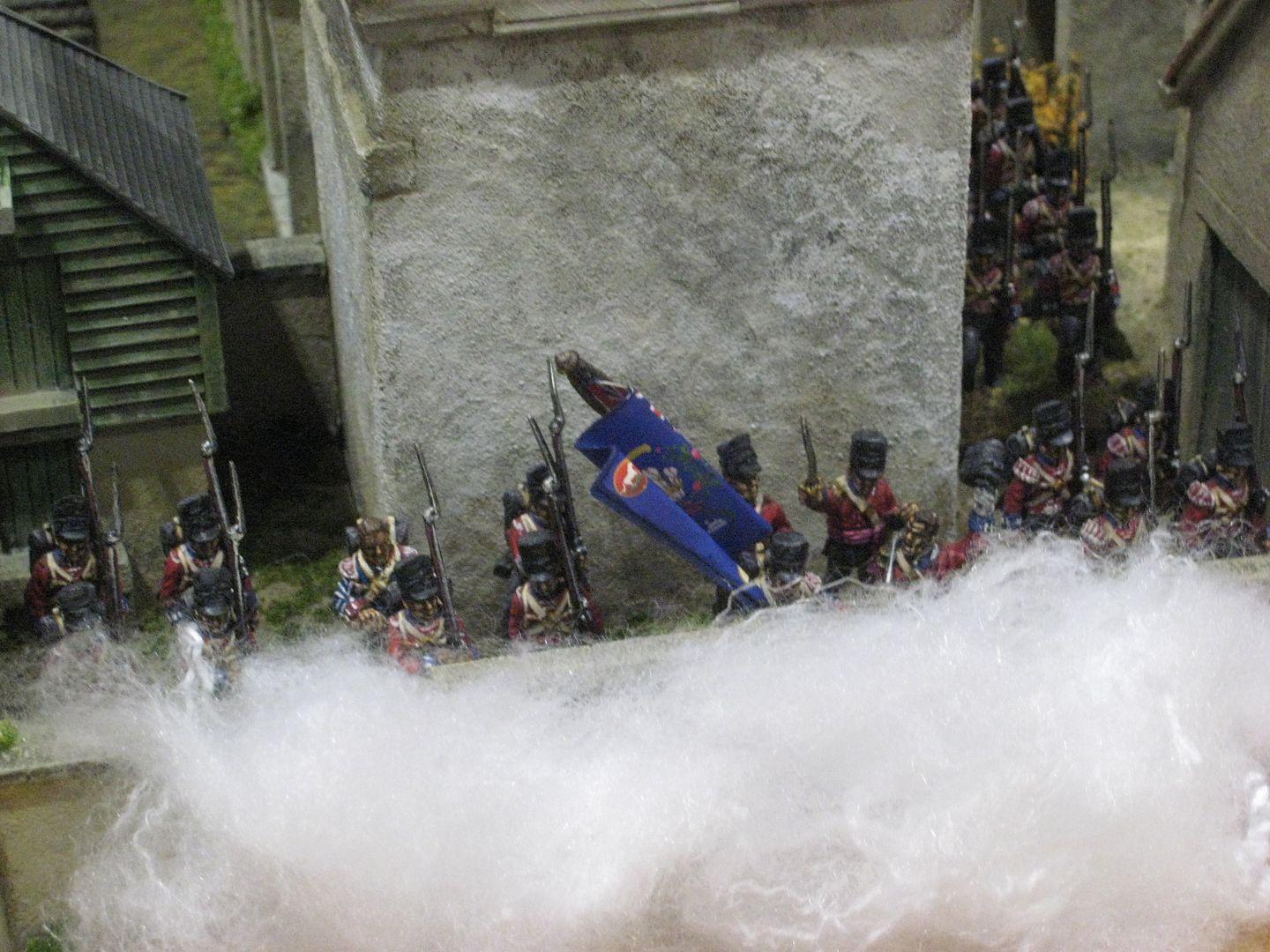
Here are some more pictures of highlanders from the King's Mountain Miniatures range.  I've posted about the firing line figures.  These chaps are "charging".  There are 4 variants (I think) and one of the casualty figures in the last photos looks as if it could well be used in a charging or advancing unit.  So not as many different figures as for the firing line, which to me is where the strength of this range lies.  But highlanders did a lot of charging, so these figures are apposite.  I painted this commission batch of the 71st all in tartan trews.  The positions of the legs makes this quite difficult, and I realised this morning, when I finished them off, that some of the black hatching across the green checks didn't quite match up.  I'll just have to hope that Bill doesn't notice... 

It's good news that the King's Mountain range is going to be made generally available.  Last year, when they were first released, it looked as if Bill had cast a limited run after which they would no longer be for sale.  That seemed a great shame at the time, and I'm delighted that these figures will continue to be available.  Anyway, here are some photos of the charging figures:


Tuesday, 11 June 2013

AWI Highlanders (6)


I had meant to post these photos when I had the charging figures all painted up, but those have been delayed so here are some initial photos of fully completed King's Mountain AWI highlanders.  As I've mentioned before, I've been working on a large commission for KM owner Bill Nevins for the past 6 months.  In due course I'll post my response to "commission painting", but suffice to say here that it's been rewarding work.  These figures here are unvarnished and lacking some final touching up.  The purpose of these photos is to show the various firing line figures from the range, and the various ways in which they can be painted.  Here is not the place to go into detailed discussion of the likely colours of overalls or whether the 71st wore tartan trews in the south.  I'll do that when I get around to painting units for my own collection.


Sunday, 9 June 2013

Hanoverian Field Jaeger Corps

These figures represent the Hanoverian army's Feldjager corps in 1815. This unit was raised from foresters and huntsmen in 1813.  Originally 2 companies strong, it was increased to 4 companies.  Only 2 of those were present at Waterloo, about 330 officers and men, in Kielmansegge's 1st Hanoverian Brigade in Alten's 3rd Division.  1 company, about 160 men, was  part of the garrison at Hougoumont, and this is the unit I have modelled here.  That's 8 figures using the General de Brigade 1:20 ratio, which is perfect because 8 figures are what you get in this excellent set from Westfalia Miniatures.  The sculpting is by Paul Hicks.

I haven't been able to find out much about these troops.  At Hougoumont, they appear to have been positioned in the wood to the south of the farm, and in due course retreated to the farm's orchard.  There was some to-ing and fro-ing as the orchard changed hands a couple of times y appear to have been  at some stage.  As for the uniforms, sources refer to "dark green" coats and "apple green" facings, with black leatherwork.  I used the Foundry "French Chasseur Green 71" for the coats and "French Dragoon Green 70" for the facings.  Officers' sashes were yellow and the rifle straps were brown leather.  The grey trousers were painted with the Foundry "Stone" palette.  I thought about basing these figures as singles, but then decided to put them on standard GdB skirmish bases.  My next idea was to pose them in a sort of "fighting retreat", with the running figure on each base moving backwards, being covered by the other figure.  But that just looked odd - I think with skirmishing figures like this you really need them to point the same way.  This is a lovely little set of figures, very well sculpted and easy to paint.  These were the first figures I painted when on paternity leave in February - I just felt I needed to paint something a bit different, and which didn't involve British red or French dark blue.

I'm slowly getting ready for "ACW Week", which I first threatened this time last year and then didn't get around to it.  To recap - I painted about 100 Dixon ACW figures last year, including many that I'd "tarted up" from about 15 years ago.  I've painted a few more ACW figures since then and I'm trying very hard to finish off my Stonewall Jackson command vignette.   

8 figures. Painted February 2013.


Tuesday, 28 May 2013

54th Ligne (1)

I'm afraid work and real life have invaded hobby time again over the past couple of weeks, so apologies for falling behind with regular posts.  Here is something that I started painting back in January 2012 and then added to from time to time until I decided to finish it off in February 2013: more Perry French infantry for Waterloo.  After finishing off Bachelu's division, I looked around to see what division to work on next.  I settled on Quiot's division in d'Erlon's I Corps, so I'm basically working my way east across the battlefield, having started with the division at the end of Jerome's Corps.  So the focal point for my Waterloo project at the moment is the area between Hougoumont and La Haye Sainte.  These are all plastic figures apart from the 3 command figures.

This is the second battlion of the 54th Line, part of the 1st brigade of the 1st division of I Corps.  I painted the brigade commander, Colonel Charlet, last year.  At 1:20 for the "General de Brigade" orbat, this battalion has 24 figures.  As I worked through Bachelu's division I decided to standardise the shako covers and greatcoats in each battalion.  I've now decided to use the colours of the shako covers to differentiate between divisions.  So while Bachelu's troops have canvas-coloured covers, Charlet's troops will have black oilskin ones.  A couple of the grenadiers have "fusilier" heads with extra moustaches that I sculpted with green stuff.  I cut off the right arm of one of the voltiguers and glued on the arm from the skirmishing figures to suggest he'd trying to adjust his straps (or something like that).  I forgot to include the additional skirmishing voltiguer bases in the photos, but they do exist.  You can also see from the photo above that I forgot I was painted grenadiers at one point, because the chap on the left of the grenadier base has a voltiguer horn on his cartridge box! The 54th is one of the French regiments for which GMB do special battalion flags.  The building in the background is by Touching History, and the walls are (I believe) from the Hovels Hougoumont sets (painted by Touching History). 

As I said above, my painting time has really take a body blow since little Monty was born.  It's not so much having to deal with 2 boys rather than 1, but rather the fact that Hugo now doesn't have his afternoon nap - this means I no longer have a good 2 hours each weekend day (and bank holidays) and so painting is limited to about 45 minutes in the evening, if I get home from work before 8pm (increasingly rare these days).  Luckily I'm still working through my backlog of finished units from earlier this year.  I'll have some 1815 Hanoverian riflemen at the end of the week.

24 figures (plus 4 skirmishers). Painted at various times from January 2012 to February 2013.  Flag by GMB.


Monday, 20 May 2013

Civilians (12)

I think this vignette holds the record for the length of time I've taken to complete something.  I can't actually remember when I started painting these figures, but it was definitely before I moved out of London, and even then the two figures I'd painted, the girl and her chaperone, had been finished for a while.  So I reckon is was about July 2011 that I began work on this scene.  I picked up all these figures when I visited Eureka Miniatures HQ in Melbourne earlier that year.  The washer-woman, old crone and water trough come from a set in the Eureka Revolutionary Wars set, which also includes a French cavalryman watering his horse.  I'm not sure where the artist figure comes from - there are all kinds of jems in the Eureka catalogue which can be difficult to find on their website.  When I visited Eureka, wargaming chums John Baxter and Mark Spackman found all sorts of things for me to buy that I'd never seen before (including a wig-maker with a giant poodle - I must paint that set sometime soon).  The reason for the massive delay in finishing this set was twofold.  First, I couldn't decide on how to paint the stone water trough.  Secondly, I was having difficulty arranging the scene and, in particular, finalising how to deal with the artist.  I had decided quite quickly that I would use all these figures together, as an early example of en plein air painting.  The tricky part, however, was working out how to make the artist's easel and whether to add any other bits to the scene.  So having painted and based the humans in 2011, I then failed to apply myself to the water-trough and the easel and consequently this vignette languished on my desk until April this year, when I shamed myself into sitting down and working through the outstanding items

As I find is often the case with "tricky" bits of modelling, the "difficult" bits didn't actually take long to finish.  I painted the water trough with the Foundry "Stone" palette, and then gave it a final drybrush with an off-white (I forget which paint exactly, but it would have been a Coat d'Arms light grey).  The easel I scratch-made from bits of matchsticks.  I spent a bit of time searching the internet for pictures of mid/late 18th century easels to see what they would look like - not many seem to have survived, but there are quite a few paintings from the period which are themselves pictures of painting scenes. That said, easel design doesn't seem to have advanced all that much over the past 300 years.  It probably the case, however, that the type of easel I made isn't the sort of thing that a painter would have taken out of the studio.  Also, the painter in this scene is probably an amateur, as most established artists in the 1770s would have been concentrating on grand historical scenes or society portraits and wouldn't have wasted their time painted the local rustics. Anyway, the easel was a bit fiddly to do in the end, the hardest part being to carve out the ridge in which the painting sits.  Once it was all glued together, I painted the easel with the Foundry "Chestnut" palette.  Looking at these photos now, I realise that I should have added some gloss varnish to the water in the tough and the washer-woman's basket.

I arranged the figures in what seemed to me to be the most satisfying way, although I appreciate that it's not clear exactly what it is that the chap is painting.  The picture itself is simply a bit of Gale Force 9 plasticard.  I did think about trying to paint the scene into it, but discarded that idea after about 5 seconds.  Rather than leave the "canvas" completely blank, I painted a "red ground" on it.  Apparently red grounds are often used by landscape painters to prepare their canvases; I read that Constable favoured a sort of mid-brown colour and I tried to replicate that here.  Making the scene look as if the artist is just about to start also meant I could put paints in the palette without smearing them around.   I haven't glued the painting to the easel - so I could in theory have a go at painting something in the future.

4 figures, a water-trough and an easel. Painted July 2011-April 2013.


Friday, 3 May 2013

South Carolina militia cavalry

To keep the AWI ball rolling, this is a unit I painted ages ago but only finished off the other day (i.e. by painting the flag).  This is a unit of American militia cavalry that is designed to incorporate various smaller legions and regiments which joined together.   The "British Grenadier" scenario for Eutaw Springs, for example, has a unit of 8 figures in respect of "South Carolina State Horse", while the Savannah scenario has a unit of 6 - this regiment is supposed to represent this sort of thing.

The figures are, of course, from the Eureka Miniatures "ragged Continental dragoons" range, so the figures come with separate hats which allows you to mix and match.  Creating this sort of irregular look is exactly what the Eureka range is all about.  The uniforms followed plate 12 of Uniformology's Book 26 on Continental Light Dragoons.  From left to right, the figures in uniform coats are: Maham's Regiment (blue faced white), Myddleton's Regiment (trumpeter), Hammond's Legion (blue faced red) and Horry's Regiment (white faced blue).  All of those units contributed troops to the South Carolina militia.

The flag is hand-painted and is simply a generic South Carolina flag.  GMB do one just like this, but it's too big for cavalry.  The size of this flag (which some may think is still too big) is the same size as Adolfo Ramos' AWI cavalry flags.


8 figures. Painted September/October 2012.


Sunday, 28 April 2013

The King's Orange Rangers

The King's Orange Rangers were raised in New York in 1776.  "Orange" refers to both the county of New York in which recruitment took place and the facings of the soldiers' coats (apparently orange was a difficult colour to reproduce, so there are likely to have been wide variations of colour in the troops' uniforms).  The metal colour of the regiment was white/silver.  The regiment does not appear to have been a particularly large one.  Chartrand in the Osprey "American Loyalist Troops" MAA records a strengths of 159 in October 1778 and "over 200" in May 1782.  The regiment was disbanded the following year.  Its uniform appears to have been green until at least 1777, with a change to red coats at some stage.  Obviously I've gone for the green coats here, with dark brown leggings.

 In the published "British Grenadier!" scenario books, this unit appears just once, in the Hudson Forst scenario of 6 October 1777.  This engagemant was part of the short-lived (and rather half-hearted) attack north from New York that was supposed to support Burgoyne's incursion southwards from Canada.  General Clinton sent a small force up the Hudson River and attacked the American garrisons at Forts Montgomery (great name) and Clinton.  The British successfully invested both forts, but the attack did little to assist Burgoyne, who surrendered at Saratoga 11 days later.  The scenario (in the 3rd book from Caliver) is an interesting one, as it has a mix of troop types on the British side, which include several loyalist units.  One such is the King's Orange Rangers, a 12-figure unit, as part of the force that attacked Fort Clinton.

The figures are, of course, the new Perry plastic British infantry.  I posted my initial thoughts on them here.  For this small unit I used one of the box's sergeants and the officer, but not the drummer or ensigns.  I think my placing of the tumplines improved as I progressed with the unit, so I feel much happier about putting these figures together now.  There is an excellent re-enactors site for this regiment here.  I'm sorry its taken a while to post a full unit of these figures - readers of Tarleton's Quarter have a right to expect quicker treatment of new AWI releases. Also, the focus on my camera is waning, I think, as these photos aren't as sharp as they should be.  Thirdly, I've noticed that the matt varnish I use has a dulling effect on the brown ink wash I use on the figures' faces - I'm checking whether this affects both metals and plastics,but I noticed it particularly with these figures; it's why some of the eyes look much darker than they should. 

12 figures. Painted March/April 2013.